
Ecuador, through its coffee landscapes.
From the Andes to the Amazon, each region shapes coffee differently
This journey moves across three distinct ecosystems, each shaping coffee through altitude, climate, and biodiversity.
Together, they reveal what origin truly means.
For those seeking to go further, an optional extension to the Galápagos Islands offers a completely different perspective.
At around 2,000 meters above sea level, just north of Quito,
coffee grows on volcanic Andean slopes under the intensity
of the equatorial sun, surrounded by giants like Pichincha and Cotopaxi.
In some farms, the equator itself runs through the land.
Coffee trees grow within diverse agroforestry systems,
alongside fruit and shade trees, rooted in living soils.
But what defines this region is contrast.
Highlands

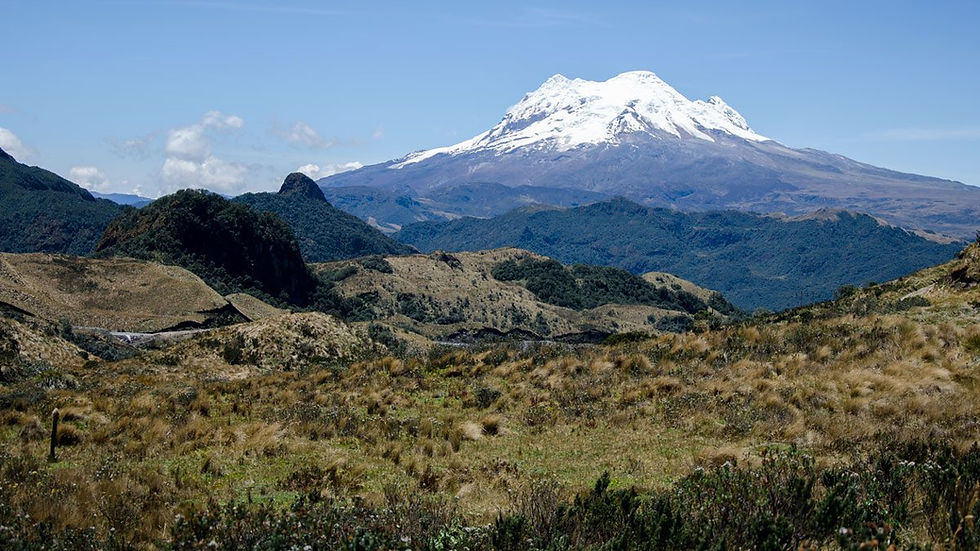
Unlike the humid cloud forests nearby, the Guayllabamba valley is dry, open, and exposed , with strong sunlight and dramatic temperature swings between day and night. These conditions slow cherry maturation, allowing density, structure, and precision to develop in the cup.
Varieties such as Bourbon, Pacamara, Java, and Caturra respond differently to altitude and exposure, producing coffees that typically range from 81 to 88+ SCA — known for their clarity, balance, and well-defined structure.
Where altitude, dryness, and equatorial light shape precision in the cup.
Sección 4

Amazon Region
Amazon Region
In the eastern foothills of the Andes, coffee grows where the mountains descend into the upper Amazon , a place where ecosystems overlap and everything feels intensely alive.
Rainfall is constant, vegetation is dense, and humidity shapes every stage of development. Volcanic soils , influenced by the nearby Reventador volcano , bring energy and fertility to the land.
Surrounded by protected areas such as Cayambe-Coca National Park and the Sumaco Biosphere Reserve, this region is defined by steep terrain, biodiversity, and the powerful transition between Andes and Amazon.
These conditions slow maturation and deepen complexity in the cup.
Varieties such as Sudan Rume, Pink Bourbon, and Typica thrive in this environment, producing coffees that frequently reach 83 to 90+ SCA with some microlots standing out for their exceptional character and depth.
But this experience goes beyond coffee.
In nearby thermal springs, naturally heated by volcanic systems, there is space to slow down, reset, and absorb the energy of the landscape.
Where coffee is shaped by volcanic energy and the living force of the Amazon.

Where coffee is shaped by volcanic energy and the living force of the Amazon.

Chocó
In the Chocó Andino cloud forest, between 1,200 and 1,800 meters above sea level, coffee grows within one of the most biodiverse ecosystems on Earth ,a UNESCO Biosphere Reserve where mist, humidity, and dense canopy shape a constantly evolving landscape.
Here, coffee develops slowly under shade, within living agroforestry systems deeply connected to the surrounding forest. Humidity, altitude, and biodiversity come together to shape coffees with layered complexity, softness, and movement in the cup.
But this territory holds more than ecological richness — it carries memory.

The Yumbos, pre-Hispanic communities who inhabited this region, lived in close relationship with water, land, and Pachamama. For them, the forest was not a resource, but a living force , a perspective that still resonates in the way this land is cultivated and understood today.
Varieties such as Typica Mejorado, Bourbon, and Sidra express this environment in different ways, often reaching 84 to 90+ SCA, with standout microlots pushing beyond.
Beyond the farms, the forest reveals itself through waterfalls, dense trails, and constant life — an ecosystem that is not observed, but felt.
Where coffee grows within a living forest, shaped by nature, history, and energy.

A place where culture, altitude, and flavor converge offering a deeper understanding of Ecuador beyond the farm.
Here, some of the country’s most recognized cafés and sensory spaces allow us to taste coffees from across Ecuador — including regions like Loja — and understand them through guided cuppings and professional calibration.
Beyond coffee, cacao adds another layer to the experience.
Widely considered among the best in the world, it reveals its complexity through tastings that connect flavor back to origin.
Quito brings everything into perspective.

Quito
At 2,850 meters above sea level, Quito rises high in the Andes, one of the highest capitals in the world, shaped by altitude, history, and a growing contemporary coffee culture.
Its historic center, a UNESCO World Heritage Site, is one of the best preserved in Latin America, where colonial architecture and layered history create a strong sense of place.
But Quito is not only about the past.
It’s where Ecuador’s modern coffee scene comes together.
Galápagos Islands

An optional extension beyond the mainland.
The Galápagos Islands are one of the few places on Earth where nature still dictates the pace of everything.
Formed by volcanic activity and shaped by isolation, the archipelago reveals landscapes that feel untouched by time — black lava fields, highland forests, and crystal-clear waters surrounded by endemic wildlife found nowhere else.
But Galápagos is not about moving fast.
It’s about slowing down.

One of the few places on Earth where nature still dictates everything.
Walking among giant tortoises, navigating dramatic coastlines, or simply observing the silence and scale of the environment , every moment invites presence.
Here, the connection between land, life, and time becomes tangible.
Not an extension of the journey, but a shift in perspective , into something deeper, quieter, and unforgettable.